Elmer Schönberger over Dubbelspoor
There is not a lot of ‘incidental music’ (the word expresses exactly what it is) that has a second life or even a little life apart from the ‘incident’, that is, apart from the film, the theatre or dance performance or the museum installation for which it was composed. Louis Andriessen’s oeuvre has a number of exceptions to this rule, such as Dances (made for a dance performance by Bianca van Dillen), the suite from Golven (for the film of the same name by Annette Apon), M is for Man, Music, Mozart (for the film of the same name by Peter Greenaway) and Odysseus’ women and Dubbelspoor, both for choreographies by Beppie Blankert. Dubbelspoor exists in two versions: a concert version with a duration of approximately fourteen minutes and the original version, three times as long, made in 1986 for the original dance performance. The recording of this latter version, played by the composer himself at the time, is heard in the performance.
The original version of Dubbelspoor is more than ‘incidental’, that is to say more than just a sound decor or support for the dance. It holds up a mirror to the choreographic concept that underlies the performance. The music could also have been called Driespoor, since the same piece is played three times during the performance, that is to say: the same and yet not the same. The same because the same musical story is told three times. Not the same for two reasons. Firstly, because the instrumental line-up is constantly increasing: a piano is added to the harpsichord that exposes the musical material in the first repetition, after which celesta and glockenspiel complete the sound image in the second repetition. But above all, it is not the same because the sound doublings of the original material are somewhat out of plumb, crooked, to put it in carpenter’s terms. Small differences in timing make what was once tight grainy, entries come just too early or just too late, time falters.
Just as unreal as the mirrored world is the ‘shadow melody’ that Andriessen introduces – as he did earlier in De Tijd (1980). The notes that together form a chord are silenced one after the other. In other words, only when a note no longer sounds does it become a melody. The shadow melody is a melody with retroactive effect.
Dubbelspoor is a performance about waiting. Just like the choreography, the music of Dubbelspoor has the vagueness that goes with it. A certain impatience too. Although the tempo is unchanging, the music has a slightly escalating character. The movement intensifies, first through the introduction of eighth notes, then through those of sixteenth notes, and finally culminates in a boogie-woogie-like cadence. These slightly swinging sounds will remind those familiar with Andriessen's oeuvre of De Stijl, a composition he completed a year earlier and in which Beppie Blankert played a prominent role, speaking and moving.
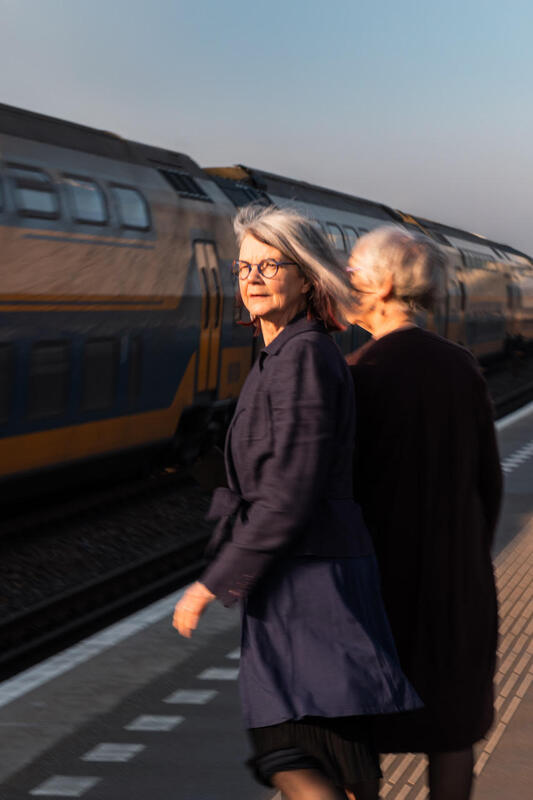
Beppie Blankert en Caroline Dokter - Dubbelspoor 2025.
Foto: Charlotte Reijnen
Er is niet heel veel ‘incidental music’ (het woord drukt precies uit wat het is) die los van het ‘incident’, dat wil zeggen, los van de film, de toneel- of dansvoorstelling of de museale installatie waarvoor zij gecomponeerd is, nog een tweede leven of zelfs maar leventje heeft. Het oeuvre van Louis Andriessen kent een aantal uitzonderingen op deze regel, zoals Dances (gemaakt voor een dansvoorstelling van Bianca van Dillen), de suite uit Golven (voor de gelijknamige film van Annette Apon), M is for Man, Music, Mozart (voor de gelijknamige film van Peter Greenaway) en Odysseus’ women en Dubbelspoor, beide voor choreografieën van Beppie Blankert. Dubbelspoor bestaat in twee versies: een concertversie met een duur van ongeveer veertien minuten en de oorspronkelijke, drie keer zo lange versie, in 1986 gemaakt voor de oorspronkelijke dansvoorstelling. Van deze laatste versie klinkt de destijds door de componist zelf ingespeelde opname.
De oorspronkelijke versie van Dubbelspoor is meer dan ‘incidental’, dat wil zeggen meer dan louter geluidsdecor of ondersteuning van de dans. Zij houdt het choreografische concept dat aan de voorstelling ten grondslag ligt een spiegel voor. De muziek had ook Driespoor kunnen heten, aangezien tijdens de voorstelling drie keer hetzelfde stuk klinkt, dat wil zeggen: hetzelfde en toch niet hetzelfde. Hetzelfde omdat drie keer hetzelfde muzikale verhaal wordt verteld. Niet hetzelfde om twee redenen. In de eerste plaats omdat de instrumentale bezetting steeds groter wordt: bij het klavecimbel dat het muzikale materiaal exposeert voegt zich in de eerste herhaling een piano, waarna in de tweede herhaling celesta en glockenspiel het klankbeeld completeren. Maar vooral niet hetzelfde omdat de klankverdubbelingen van het oorspronkelijke materiaal enigszins uit het lood staan, scheluw, om het in timmermansbewoordingen te zeggen. Kleine verschillen in timing maken wat eerst strak was korrelig, inzetten komen precies te vroeg of precies te laat, de tijd hapert.
Even irreëel als de gespiegelde wereld is de ‘schaduwmelodie’ die Andriessen – zoals eerder al in De Tijd (1980) – introduceert. Van de tonen die samen een akkoord vormen wordt de een na de ander het zwijgen opgelegd. Anders gezegd, pas op het moment dat een toon niet meer klinkt, wordt hij melodie. De schaduwmelodie is een melodie met terugwerkende kracht.
Dubbelspoor is een voorstelling over wachten. Net als de choreografie kent de muziek van Dubbelspoor de onbestemdheid die daarbij hoort. Een zeker ongeduld ook. Hoewel het tempo onveranderlijk is, heeft de muziek een licht escalerend karakter. De beweging intensiveert, eerst door de introductie van achtste noten, dan door die van zestiende noten, en culmineert uiteindelijk in een boogiewoogie-achtige cadans. Deze licht swingende klanken zullen bij kenners van het oeuvre van Andriessen herinneringen oproepen aan De Stijl, een compositie die hij een jaar eerder voltooide en waarin Beppie Blankert sprekend en bewegend een prominente rol speelde.